Territory Management vs. Site Selection: Why Service-Based Brands Need a Different Approach
Service-based franchises don’t need the perfect storefront—they need the right territory. The brands winning today are moving beyond population-based shortcuts and using real customer demand to design territories that actually set franchisees up for success.
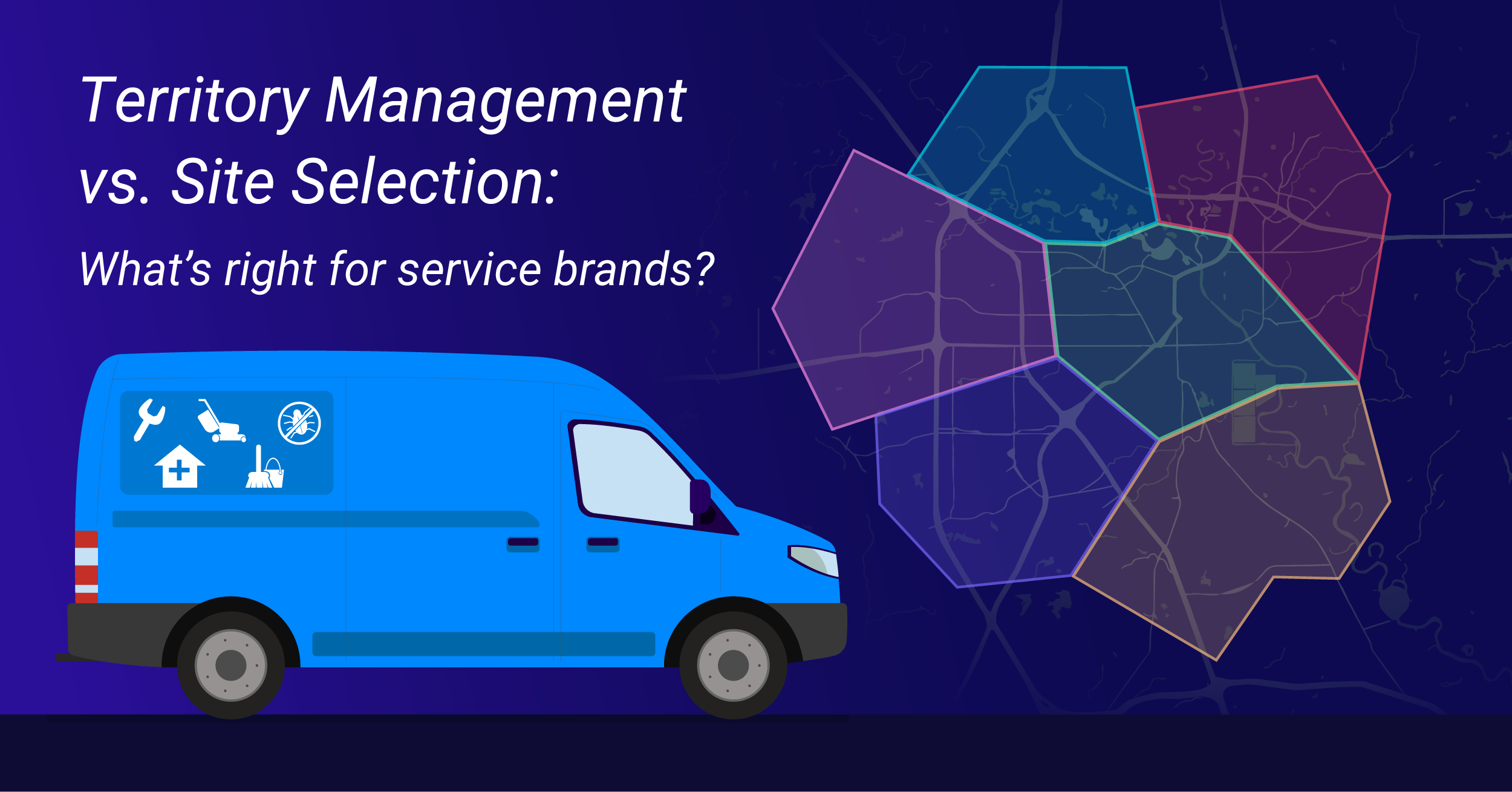
When most people hear “site selection,” they picture a map dotted with pins. A brand looking for the right corner. A real estate team evaluating traffic counts, co-tenancy, visibility from the road. A demographic model that predicts how much revenue a specific address might generate.
That’s the right mental model if you’re opening a restaurant, a fitness studio, or a retail location. If your customers come to you, then choosing the right place to be is everything.
But what if your customers never come to you? What if the entire premise of your business is that you go to them?
For the fastest-growing category of franchise brands in 2026 — home services, healthcare, HVAC, pest control, junk removal, cleaning, restoration, and dozens of other field service businesses — the site selection playbook simply doesn’t apply. These brands don’t need the right address. They need the right territory. And that distinction, as obvious as it sounds, has massive implications for how they should be making expansion decisions.
The good news is that the analytical problem service brands are solving is, in some ways, simpler than brick-and-mortar site selection. The challenge is that most haven’t been solving it with much rigor — and the gap between what’s possible and what’s common practice is significant.
The Site Selection Industry Was Built for Stores
The data infrastructure behind modern site selection is impressive. Trade area analysis, foot traffic heat maps, co-tenancy scoring, drive time modeling, visibility indices — these are genuinely powerful tools for understanding whether a specific location will perform.
They were also built almost entirely for brands where customers make an active decision to travel to a physical space.
Think about what foot traffic data actually measures: how many people walk or drive past a given point, and where those people come from and go to. That information is invaluable for a QSR brand choosing between two available end-cap spaces. It’s essentially irrelevant for a franchise that dispatches technicians to customer homes.
The same is true for most of the other core data inputs that site selection tools are built around:
- Visibility scores assume customers discover you because they can see your sign. Service brands are found online.
- Co-tenancy analysis looks at what other businesses are nearby and whether they drive complementary traffic. Service brands don’t benefit from being next to a coffee shop.
- Parking and access models assess how easy it is for customers to visit a location. Service brands need to know if technicians can efficiently route across a service area.
None of this is a criticism of site selection as a discipline. These are the right tools for the right problem. The issue is that service-based franchise expansion is a fundamentally different problem — and one that deserves its own framework.
How Service Brands Actually Think About Expansion
For a service-based brand, growth isn’t about finding a better address. It’s about identifying the right demand concentration within a geographic area, and then defining, assigning, and protecting a territory that makes a franchisee’s business viable.
The core questions look very different:
- Is there enough demand in this area — enough households, businesses, or qualifying customers — to support a franchisee at the volume targets we’ve modeled?
- Are adjacent territories already assigned? If a franchisee in this territory grows aggressively, will they run into a neighboring franchisee’s customer base?
- What does the right territory boundary look like? Zip codes? County lines? A custom polygon drawn around a specific concentration of the right customer profile?
- Where are our coverage gaps? Which markets have sufficient demand but no active franchisee?
- Is a potential new franchisee walking into a territory with realistic upside, or are we setting them up to struggle?
These are the questions that drive franchise development decisions for service brands. And critically, they’re more tractable than the equivalent questions for brick-and-mortar expansion. Within a defined territory, a franchisee has exclusive rights. There’s no cannibalization risk from a neighboring unit drawing customers away — territory boundaries exist precisely to prevent that. The core analytical challenge is straightforward: supply versus demand. Is there enough of the right kind of customer in this area to sustain the business?
The Real Gap Isn’t the Data — It’s the Rigor
Here’s the thing that makes the current state of service brand territory design somewhat ironic: the inputs needed to do this well are largely available. Brands have customer address data. Detailed demographic and consumer segmentation layers exist. Mapping and visualization tools are accessible. The raw material for rigorous territory design is there.
What’s missing, for most brands, is the discipline to actually use it.
The most common approach to territory design in service franchising is also the simplest one: total population. Draw a boundary around a county, a cluster of zip codes, or a radius, check that the population figure clears a threshold, and call it a territory. It’s fast, it’s defensible in a surface-level way, and it requires almost no analytical effort.
It also frequently produces territories that are wildly unequal in actual opportunity.
Consider a home cleaning franchise. Their target customer isn’t “any person in this geography.” It’s dual-income households above a certain income threshold, in homes above a certain size, in areas where the labor supply to deliver the service exists at manageable cost. A territory with 200,000 total residents might contain 45,000 households that fit that profile — or 12,000, depending entirely on where you’re looking. Two franchisees entering territories with identical population counts can be walking into fundamentally different businesses.
The same dynamic plays out across service categories. HVAC franchises care about housing age and density. Pest control franchises care about climate, home ownership rates, and property type. Home health and senior care franchises care about age demographics and proximity to healthcare infrastructure. Total population tells you almost nothing about any of these things.
Most service brands know this intellectually. Plenty of them have customer address data sitting in their CRM that could be turned into a real customer profile. The gap isn’t awareness of the problem — it’s that translating that data into territory design requires a level of analytical infrastructure and workflow discipline that most franchise development teams haven’t built.
Designing Territories for Franchisee Success, Not Unit Count
The organizational pressure that drives the total-population approach is worth understanding, because it’s real and it’s not going away on its own.
Franchise development teams have unit count targets. Smaller territories mean more territories to sell, which means more units opened, which means hitting the number. The incentive structure pushes toward drawing tighter boundaries — and total population provides a convenient justification for doing so. Nobody looks at a territory with 200,000 residents and immediately thinks it’s too small.
But the consequences of undersized territories — undersized in terms of real customer demand, not just headcount — play out over years. Franchisees in thin markets struggle to hit volume targets. They need more marketing support. They generate more franchisee relations friction. They don’t renew, or they exit the system in ways that are messy for everyone. The short-term unit count win becomes a long-term network health problem.
The alternative is a design philosophy centered on a different question: what territory gives this franchisee a realistic path to success?
That question produces territories that vary meaningfully by market. A franchise in a densely populated urban area where the target customer profile is highly concentrated might receive a relatively tight geographic boundary — and still have abundant demand to work with. A franchise in a more spread-out suburban or exurban market where the same customer profile is more diffuse might receive a much larger geographic area to achieve equivalent opportunity. The boundaries look different. The opportunity is comparable.
This approach also changes the franchisor’s relationship with its territory map over time. Instead of a grid of uniform boxes, the network reflects the actual distribution of demand. High-density markets are served by franchisees with focused territories and high throughput. Lower-density markets are served by franchisees with broader coverage areas. The system is calibrated to reality.
Getting there requires data — specifically, the ability to model customer profile density across geographies, visualize proposed territory boundaries against that demand layer, and compare options before committing. It also requires a franchise development process that has the tools and discipline to do this analysis consistently, not just when someone raises a question about a specific market.
Why This Matters More Now Than Ever
Service-based franchising is not a niche corner of the industry. It is, by most measures, the sector with the most growth momentum heading into 2026.
Home services, health and wellness, personal care, restoration, and field service businesses collectively represent some of the strongest unit economics and franchisee satisfaction metrics in the franchise world. The “do-it-for-me” consumer mindset — the preference for outsourcing tasks that previous generations handled themselves — has created durable, needs-based demand that holds up better than discretionary categories in economic downturns.
Brands like Neighborly, which operates dozens of distinct service franchise concepts, and ServiceMaster, along with a growing list of emerging concepts in cleaning, restoration, home health, and specialty services, are building networks at scale. Aussie Pet Mobile added over 130 territories in under two years. The category is growing fast.
As networks scale, the consequences of imprecise territory design scale with them. A franchisor managing 50 territories can probably absorb the inequities that come from a total-population approach. A franchisor managing 500 or 1,000 territories across multiple markets cannot — the accumulated effects of poor territory design show up in franchisee performance variance, in development friction, and eventually in system health metrics that are hard to reverse.
The brands that build rigorous territory design into their process now — while the network is still manageable — are the ones that avoid having to fix it later under pressure.
A Better Starting Point
The practical starting point for better territory design isn’t complicated, even if the execution requires some investment.
It starts with your own customer data. Most service franchisors have years of customer transaction records — addresses, service types, frequency, revenue per household. That data, analyzed properly, produces a real picture of who your best customers are and where they concentrate. It’s the foundation of demand modeling, and it’s already sitting in your systems.
From there, the question becomes how to map that customer profile against potential territory geographies — visualizing density, identifying coverage gaps, modeling how a proposed territory boundary interacts with adjacent ones, and building the documentation to make territory decisions defensible when franchisees ask questions.
SiteZeus is built to support this kind of territory intelligence — giving service-based brands the tools to move from population benchmarks to demand-driven territory design, and to do it consistently at scale. Recent enhancements to the platform have deepened these capabilities specifically for non-brick-and-mortar brands, recognizing that the expansion playbook for service franchises has distinct requirements that deserve a purpose-built approach.
The data is available. The customer profile exists. For most service brands, what’s been missing is the analytical layer that turns those inputs into territory decisions their franchisees can build a business on.
See How SiteZeus Handles Territory Management
If your brand is growing through service-based franchising — or if you’re operating a mix of brick-and-mortar and service concepts — and you want to see what demand-driven territory design looks like in practice, we’d like to show you. Request a demo →

Recommended Posts