How Brands That Open Dozens of Units a Year Actually Pull It Off
What separates the brands opening dozens of units a year — or more — smoothly from the ones constantly putting out fires isn’t the checklist — it’s the workflow around it. Here’s how the brands opening units at scale actually manage the process.
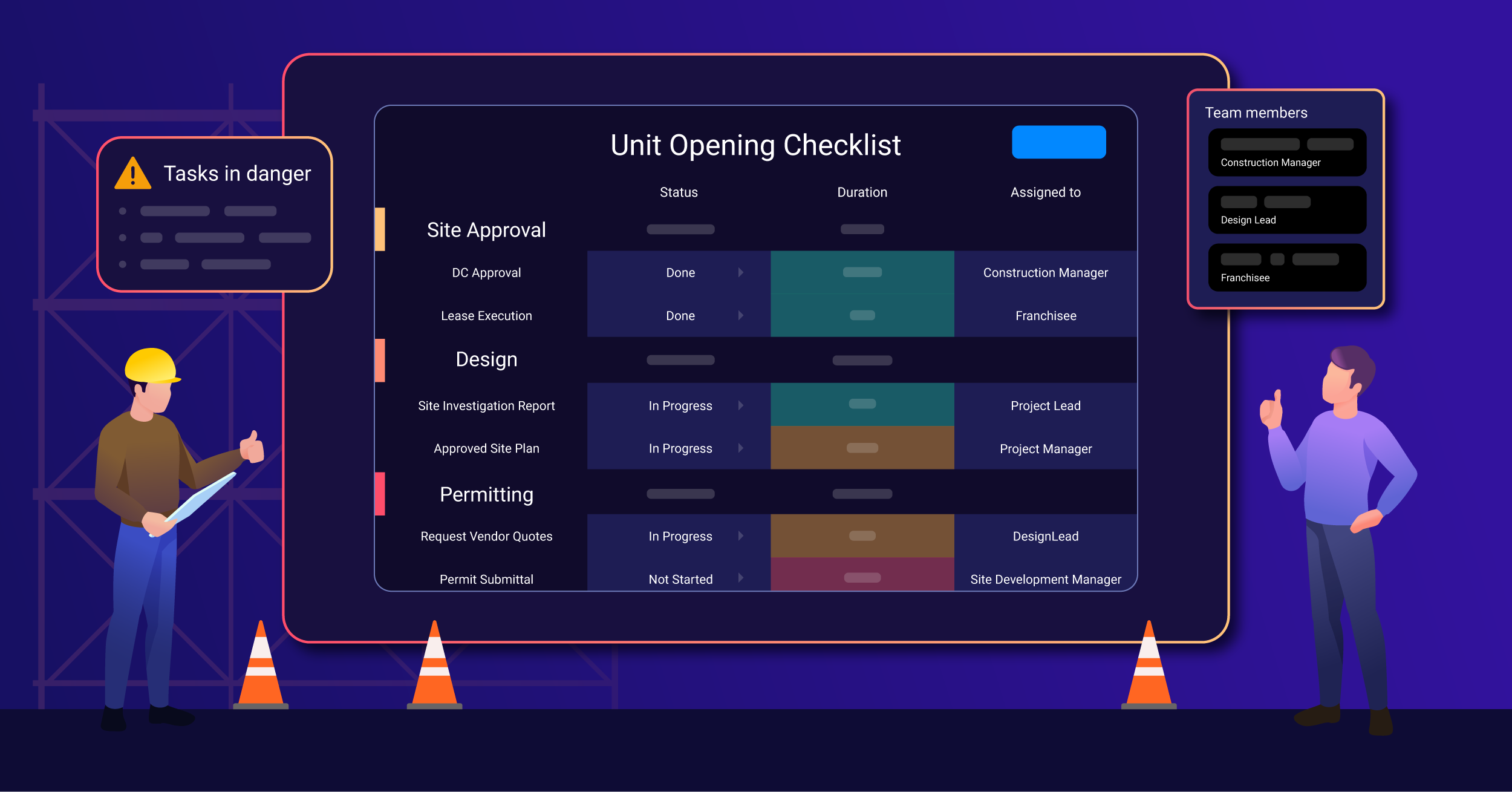
Closing on a new unit is supposed to be a milestone for the team — and for most multi-unit brands, it’s also the moment central visibility on the opening quietly disappears. Real estate hands off to construction, construction coordinates with operations, operations loops in marketing for grand-opening prep, and each team starts managing its own slice of the project in its own tool. Progress lives in inboxes, spreadsheets, and the occasional check-in call — until something slips.
Most brands have a checklist for what needs to happen between the deal closing and grand opening. The brands opening dozens of units a year — or more — smoothly aren’t winning because their checklist is better. They’re winning because the workflow around the checklist is built to scale — with shared visibility, predictable handoffs, and early warning when something is about to slip.
Where unit opening processes break down at multi-unit brands
Most opening delays don’t come from one big problem. They come from a series of small handoffs that didn’t get caught in time. A permit comes back with a condition no one routed to construction. A long-lead equipment item slips a delivery date and the GC finds out four days later. The hiring plan kicks off two weeks late because no one updated the construction milestone that triggers it. None of these are dramatic on their own. Stack three of them on the same project and the grand-opening date moves.
The shape of the problem is consistent across brands: information moves between teams, but it doesn’t move with the work. A status update lives in a project manager’s head, a contractor’s email, a marketing planner’s spreadsheet — and the central opening team has to assemble the picture by hand every time someone asks where things stand.
The cost shows up in places leadership feels: lost revenue days when an opening slips, wasted marketing spend when a grand opening gets rescheduled, and a slow burn on team morale when every project feels like its own emergency.
Managed vs. reactive unit opening processes
A reactive opening process treats every opening as its own project. Status gets pulled together ad hoc — someone asks, someone chases, a spreadsheet gets updated. Surprises get absorbed wherever they land: the construction PM working late, the real estate director making calls, the ops director rebuilding the staffing plan.
A managed opening process runs the same workflow every time. The right people see the right information without asking for it. Surprises still happen — they always will — but they get caught early because the process is built to expect them. Knowing where things stand stops being a separate task and becomes a byproduct of running the project.
You can see the difference role by role. A real estate director isn’t pulled back into status updates on sites that have already been signed. A construction PM stops rebuilding the same status report for three different audiences each week. An ops director doesn’t find out about a delayed opening from the field. Across the team, the work that actually moves an opening forward gets the time it deserves, instead of getting crowded out by the work of tracking the work.
A managed process isn’t about more meetings or more reporting. It’s about reducing the work it takes to know where things stand.
What a scalable unit opening process actually looks like
Strip away the brand-specific tasks and the operational shape of a strong unit opening process is consistent. Modern construction project management software for multi-unit brands tends to put four things in place:
- One process, run many times. Stages are standardized, handoffs are standardized, and the definition of “ready to move forward” is the same on opening number 12 as it is on opening number 112. New projects don’t get reinvented — they get spun up.
- Cross-team visibility by default. Real estate, construction, operations, and marketing all work from the same picture of the project, instead of each team stitching one together. The picture updates as the work updates.
- Early-warning logic built into the workflow. The process flags risk to the schedule before the schedule slips, not after. A late milestone, a missed handoff, a long-lead item that hasn’t cleared procurement — all of that surfaces while there’s still time to course-correct.
- Accountability without bottlenecks. Every stage has a clear owner, but no single person is the routing layer for every decision. Information flows where it needs to go without going through one inbox.
None of this prescribes a specific task list. Every brand’s task list is different — different segments, different formats, different markets, different franchise structures. The shape above is what scales. The tasks live inside it.
Why a repeatable opening process scales better than hustle
Brands opening dozens of units a year aren’t faster because their teams work harder. They’re faster because the process does more of the work. Hustle gets a brand through its early openings. Past a certain volume, hustle hits a ceiling — and the brands that break through aren’t the ones hiring more project managers, they’re the ones replacing tribal knowledge with workflow.
Process is also what new team members inherit. A new construction PM joining a brand with a managed opening process is productive in weeks. Joining a brand running on hustle, the same person inherits a folder structure, a list of vendor contacts, and a vague sense of how the last opening went.
That’s where SiteZeus Build comes in. SiteZeus Build gives multi-unit brands one place to manage the opening process across every unit — standardized stages, cross-team visibility, and the early-warning logic that catches problems before they slip into the schedule. Open more units, faster, with less chaos. It’s a process outcome — and the brands that have already made the switch are the ones the rest of the market is starting to chase.
See how SiteZeus Build manages the unit opening process at scale.
Monitor development projects, control costs, and optimize communication with SiteZeus Build.
Recommended Posts