How Brands Are Actually Using Agentic Site Selection to Expand Smarter
The Atlas release of SiteZeus Locate changes who can access site selection data, when, and in what form. Here are four scenarios showing how expansion teams are getting answers faster — with reasoning they can show.
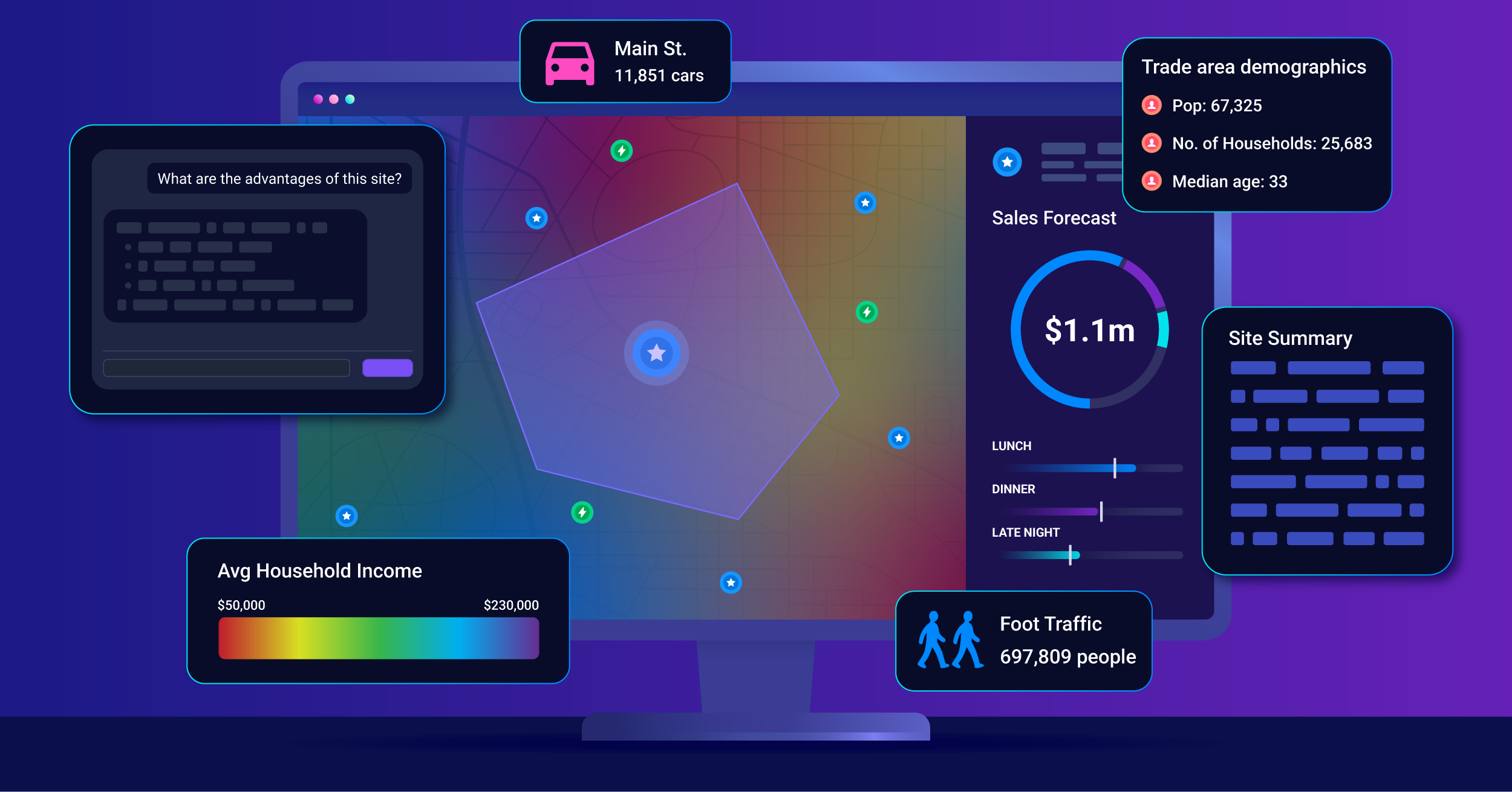
The best way to understand what the Atlas release of SiteZeus Locate changes for an expansion team isn’t a features list. It’s watching it tackle a real decision you’re already facing — the kind of call your team has to make before the next review. That’s where the difference actually lives.
Here are the top four scenarios that agentic site selection unlocks.
Scenario 1: Answering the pipeline question before the meeting
The CDO has a pipeline review in 90 minutes. Three DMAs are on the table. She needs to know which one to prioritize and why — not a full market analysis, but enough to walk into the room with a recommendation she can defend.
The old way: She kicks off the usual back-and-forth with analytics to scope what she needs. Even with everyone moving fast, the answer comes back as a static deliverable — a PDF built from last week’s data pull, which doesn’t yet reflect the competitive picture that changed when a key competitor opened in DMA two last month. The format can’t keep up with a question that’s still moving. She makes the call on incomplete information and tells herself she’ll validate it afterward.
With SiteZeus Locate: She opens Ask Zeus. In plain language, she asks for a comparison of the three markets — customer movement patterns, competitive density, demographic composition, and consumer behavior signals. She gets back charts and infographics alongside plain-language reasoning she can read in three minutes. She follows up with a question about the traffic picture in the market she’s leaning toward. By the time the meeting starts, she has an answer with a visible rationale — not just a number.
What changes: The decision moves with the meeting instead of after it. The CDO doesn’t walk in with a forecast she can’t explain. She walks in with reasoning.
Scenario 2: Locking a site in a fast-moving market
A real estate director is tracking a market where the right corner rarely stays available for more than a few days. Her team runs evaluations the traditional way: a broker sends listings, someone copies addresses into the platform, each site gets analyzed in sequence, results get compiled. By the time the analysis is complete, the site she most wanted has traded.
The old way: Three or four hours per site, and it’s all sequential — wait for the broker’s listings, copy each address into the platform one at a time, run and wait on a forecast for each, then pull the results back together into something comparable. Ten sites means a week. In a market moving at this pace, that’s too slow.
With SiteZeus Locate: Active for-sale and for-lease listings render directly on the map alongside demographic, traffic, and competitive data. She can see what’s available as she’s looking at the market — no copy-paste, no separate search. One click on any listing runs a full sales forecast. She’s evaluating in parallel, not in sequence, and the analysis happens in the time a competitor is still building the spreadsheet.
What changes: Speed becomes a competitive advantage. Her team evaluates ten sites in the time it used to take to analyze one, and the decision window on a fast-moving property stops being the constraint.
Scenario 3: The territory map a franchise prospect asked for on a call
A franchise developer is mid-conversation with a prospect who wants to expand into a new market. The prospect asks: “What does the territory look like in the Phoenix metro?” It’s a reasonable question. The developer doesn’t have the answer in front of her.
The old way: She tells the prospect she’ll get back to them. Someone on her team runs the territory model — manually pulling the inputs, running the algorithm, formatting the output. Forty-eight hours later, the territory profile lands in the prospect’s inbox. The momentum from the call is gone.
With SiteZeus Locate: The automated territory algorithm builds balanced territories from the brand’s actual transaction data — weighted toward the customer segments that drive revenue, balanced against territories that are already sold or committed. Because that work happens up front rather than as a one-off scramble, the developer has a current territory view ready to bring up — and a quick, low-effort follow-up turns it into something she can send within hours, not days: here’s what the Phoenix territory is built on, here’s the customer opportunity it represents, here’s how it sits relative to the surrounding markets.
What changes: “Let me get back to you in a couple of days” becomes “I’ll have it to you today.” The conversation keeps its momentum because the turnaround matches the pace of the deal.
Scenario 4: The committee report that used to take a week
A real estate manager is responsible for producing site evaluation reports for the real estate committee. The committee meets monthly. Every meeting requires the same format — forecast, trade area summary, competitive snapshot, market context — applied to the three or four sites currently under evaluation. The manager rebuilds it from scratch each time.
The old way: Pull the forecast. Export the charts. Build the slide. Clean up the formatting. Route it for review. The analyst whose job is to find good locations is spending a meaningful portion of her week doing document assembly.
With SiteZeus Locate: Every Ask Zeus answer is a reusable building block. The manager builds a reporting template through conversation — the layout the committee already approved, with the sections they care about in the order they want them. She saves the template. Every month, she runs it. The inputs update; the format doesn’t change. A last-minute addition to the agenda means running a new Ask Zeus conversation and dropping it into the template — not rebuilding the deck.
What changes: The analyst’s time goes back to analysis. The manager doesn’t spend the week before the meeting in a document. The committee gets consistent, professional output every time — and the institutional knowledge about what good reporting looks like gets baked into a template, not lost when someone leaves the team.
The common thread
These four scenarios are different roles, different problems, and different parts of the expansion workflow. What they share is the same underlying constraint: the path from question to answer ran through a queue, a ticket, or a multi-step manual process that was slow enough to change the quality of the decision.
The Atlas release of SiteZeus Locate doesn’t change the inputs that drive good site selection — the demographics, competitive density, traffic patterns, customer movement patterns, consumer behavior signals, and consumer interests that have always been used to build explainable forecasts. What it changes is who can access those inputs, when, and in what form. The CDO on her way into a meeting. The real estate director watching a site disappear. The franchise developer mid-conversation with a prospect. The analyst who should be analyzing, not assembling.
The expansion teams putting SiteZeus Locate to work aren’t necessarily running more meetings or more analysis cycles. They’re just getting answers faster, with reasoning they can show — and making decisions at the pace the market actually moves.
Recommended Posts