The Service Brand Playbook for Modern Territory Management
For service-based franchise brands, territory design determines whether operators thrive or fight over the same customers — and most brands are getting it wrong. This playbook breaks down how modern service brands are rethinking territory strategy to protect franchisee earnings and build for sustainable growth.
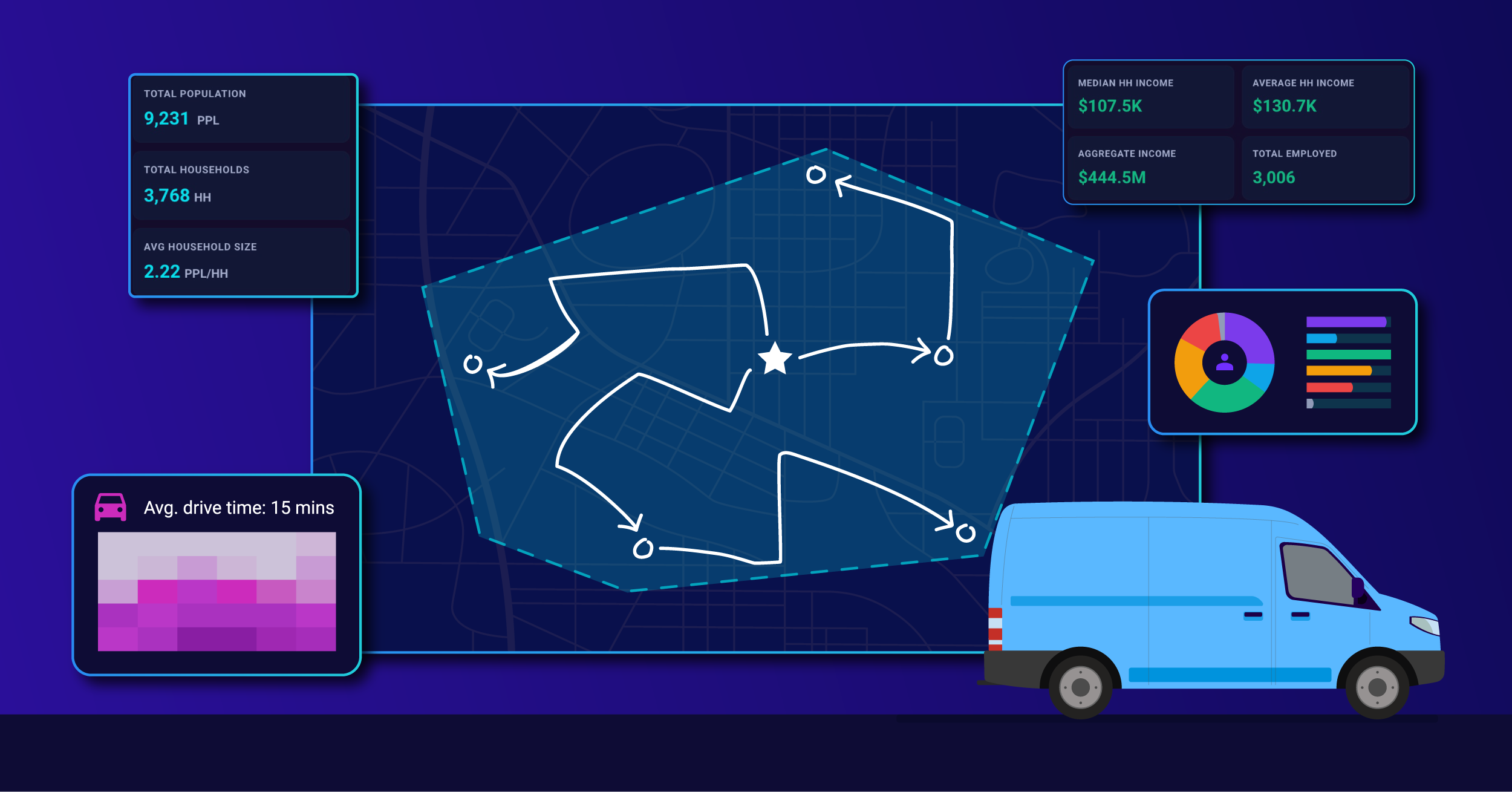
For retail and restaurant brands, a location decision is anchored to a physical address. The site either works or it doesn’t. For service-based brands — pest control companies, lawn care franchises, mobile groomers, home cleaners, HVAC operators — there’s no storefront to anchor the map. The business travels to the customer, and that changes everything about how territory design needs to work.
When a service brand gets territory right, operators have equitable earning potential, the coverage area makes sense, and growth feels manageable. When they get it wrong, franchisee conflict follows, certain operators are set up to underperform, and the problems compound as the brand scales. This is the practical playbook for getting it right.
What Makes Service Brand Territory Design Different
Retail territory logic starts with trade areas: how far will a customer drive? Service brand territory logic starts with a different question: how far can your operator realistically travel — and how much demand exists in that radius?
That shift matters more than it sounds. A territory that looks balanced on a map can be deeply unworkable in the field. Drive times between jobs eat into daily capacity. A territory spread across low-density suburbs requires more windshield time than one with the same square footage in a denser area. Population alone doesn’t tell you whether demand is there, or whether it’s clustered in ways that make efficient routing possible.
Three dynamics make service brand territory design meaningfully more complex than retail footprint planning:
Demand density is uneven — and it moves. Neighborhoods change. New developments bring new customers. Demographic shifts change which services are in demand and where. A territory drawn five years ago may reflect a market that no longer exists in the same form.
The territory is the product. For a franchisee or independent operator, the territory they’re assigned largely determines their ceiling. Unlike a retail operator who can invest in marketing to drive more foot traffic, a service brand operator’s revenue potential is largely bounded by what’s inside their coverage area. That makes equity in territory design a fairness issue, not just a planning one.
Operators are interdependent. In retail, two locations in the same brand can coexist relatively independently. In service brands, adjacent territories interact constantly. Coverage gaps, overlapping service areas, and routes that cross between territories all create friction — between operators, between operators and customers, and between the brand and its network.
The Building Blocks of a Well-Designed Service Territory
Strong territory design for service brands isn’t about drawing circles on a map. It’s about building coverage areas that hold up operationally, financially, and as the brand grows. Four elements define what that looks like.
Equitable demand distribution. “Equal” and “equitable” aren’t the same thing in territory design. Two territories with identical square footage can have wildly different revenue potential depending on the density, demographics, and demand signals within them. The goal is coverage areas where each operator has a reasonably comparable opportunity — not identical geographies.
Drive-time viability. A territory has to make operational sense for the person running it. That means accounting for realistic travel time between job sites, appointment density within the coverage area, and how efficiently an operator can move through their territory in a given day. Territories that look fine on paper can be genuinely unworkable once a technician is routing between jobs at 8 AM.
Competitive density factored in. Where are competitors already operating? Where are they concentrated? And where is the addressable demand actually uncontested? These questions are especially important for brands entering new markets, where territory design sets the foundation for how much of the addressable opportunity the brand can realistically capture.
Built to scale. The best territory designs aren’t just functional today — they’re designed with growth in mind. What happens when the brand adds a new operator in an adjacent market? When the service area needs to be subdivided to accommodate expansion? Territories designed without scalability in mind create renegotiation and conflict down the road.
When Territory Designs Start to Strain
Territory conflicts rarely appear all at once. They build. The early signals are worth knowing — catching them early is significantly less disruptive than addressing them after they’ve created real friction in the network. The three most common strain points:
- Performance inequity across operators. High-performing operators in dense markets alongside underperforming operators in lower-demand areas — with little obvious explanation beyond their coverage area — is often the first indicator that the initial design created inequity. When operators start comparing notes, as they will, the perception of unfairness follows quickly.
- Expansion pressure on existing boundaries. What felt like reasonable boundaries for a 10-operator network may not work when the brand reaches 50. New operators need somewhere to go, and creating space for them without creating conflict with existing operators requires that the original territories were designed with that flexibility in mind.
- Coverage gaps that erode customer retention. Customers in certain areas of a territory may have longer wait times or lower service quality because they’re at the edge of an operator’s range. Those gaps are often invisible until a pattern emerges in the service data.
How Data-Driven Territory Design Addresses Each of These
The core limitation of traditional territory design is that it relies on static inputs — a map, a population estimate, and judgment. Markets shift. Customer behavior patterns change. The inputs that shaped a territory in year one are rarely the same inputs that would optimize it in year three.
Data-driven territory design starts from a different foundation. Instead of drawing boundaries based on geography and gut feel, it models coverage areas based on actual demand signals: demographics, customer movement patterns, competitive density, consumer behavior signals, and consumer interests. The result is territories that reflect where demand actually exists, not where it looks like it should exist.
Scenario modeling changes the planning process in a specific way that matters: you can see the tradeoffs before you commit. What happens to operator A’s territory if a new operator is added to the north? What does equitable demand distribution look like across six territories instead of four? These questions used to require extensive manual analysis. Modeling them before making decisions reduces the cost of getting it wrong.
Territory design also benefits from being revisited. Markets evolve, and coverage areas that made sense at launch may need adjustment as the brand scales or as demographics shift. Building in a process for reviewing territory performance over time — and having the data infrastructure to support that review — is what separates brands that manage territory conflict proactively from those that manage it reactively.
Getting territory design right doesn’t guarantee smooth operator relationships or consistent performance across a network. But getting it wrong almost guarantees problems. For service brands, it’s one of the most consequential decisions in the expansion process — and one that benefits enormously from treating it as a data exercise rather than a map-drawing exercise.

Recommended Posts