Close, Relocate, or Renew: The Lease Call Most Brands Get Wrong
The lease renewal decision is one of the highest-stakes choices in multi-unit retail — and it’s usually made under the worst possible conditions. Here’s the data-driven framework that changes that.
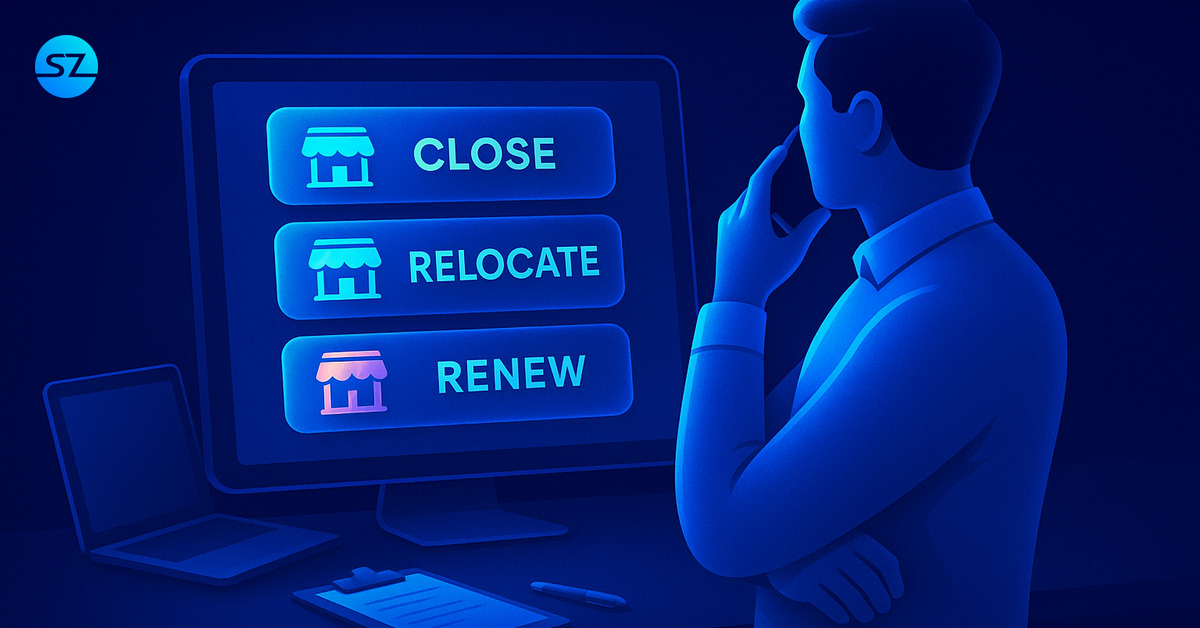
The lease renewal decision is one of the highest-stakes choices in multi-unit retail — and it’s usually made under the worst possible conditions. The deadline is set by the landlord’s timeline, not yours. The data you need to make the right call often lives in separate systems. And the wrong decision has consequences that play out over five to ten years.
Most real estate teams know what the ideal process looks like: a data-driven review of each location’s performance, a clear-eyed look at the trade area, and a recommendation that accounts for what the unit can realistically produce over the next lease term. The challenge is executing that process consistently across a portfolio — without the kind of manual effort that makes it impractical at scale.
Here’s how to structure a data-driven lease decision framework that works for all three outcomes: renewal, relocation, and closure.
The Three Decisions and What Drives Them
Renewal: When the Location Still Has Runway
A renewal makes sense when the location’s performance trajectory is stable or improving, the trade area fundamentals support continued demand at a level that justifies the rent, and the competitive environment hasn’t shifted in a way that creates structural headwinds.
The key word is trajectory. A unit performing below plan in a trade area with strong demographic growth and low competition tells a different story than a unit performing below plan in a saturated market. A renewal decision should account for what the next five years are likely to look like — not just what the last two have been.
Renewal negotiations also benefit from location intelligence. When you can show a landlord objective data on trade area performance, competitive density, and customer demand, you’re negotiating with evidence — not just leverage.
Relocation: When the Site Is the Problem, Not the Market
Relocation is the right answer when the market is strong but the specific site has become a constraint. Maybe the footprint is too small for your current format. Maybe access has changed — a new development blocked the visibility that made the site work. Maybe the trade area has shifted geographically and your customers are now concentrated two miles south of where they were when you signed.
A relocation analysis starts by asking: if you were selecting a site in this market today, where would you put it? If that answer is meaningfully different from where you currently are, relocation is worth modeling. The question is whether the cost of the move — tenant improvement buildout, lease breakage, lost revenue during transition — is offset by the improved performance the new site is projected to generate.
That analysis requires current forecasting data for the candidate relocation sites, not just a gut read on where traffic has moved.
Closure: When the Unit and the Market Are Both the Problem
Closure is the right call when both the site and the trade area fundamentals are working against you — or when the unit’s performance ceiling, even under optimistic assumptions, doesn’t justify the lease cost. It’s also the right call when an underperforming location is cannibalizing a stronger nearby unit, and closure would redirect customers rather than lose them.
The hard part of closure decisions isn’t usually the math — it’s the organizational reluctance to accept that a location isn’t going to turn around. A data-driven framework takes some of that friction out of the conversation by making the case on evidence: here is the trade area forecast, here is the performance ceiling, here is the comparison against the closest alternative site.
Building the Framework: What Data You Need
A lease decision framework needs three data inputs working together:
- Current performance data: How has the unit trended over the last 12–24 months, normalized against peer units? Is the decline stabilizing or accelerating?
- Trade area fundamentals: What do current demographics, competitive density, traffic patterns, customer movement patterns, consumer behavior signals, and consumer interests tell you about the market’s underlying demand?
- Forward-looking forecast: Given the current trade area conditions, what is the unit’s projected performance over the next lease term? How does that projection compare to the rent cost and the brand’s return thresholds?
Most brands have the first input — performance data — in their reporting systems. The second and third inputs require location intelligence data that connects the unit’s performance to the conditions in the market around it.
Without that connection, you’re making a lease decision based on what happened — not on what’s likely to happen next.
Common Mistakes in Lease Decision Analysis
Reviewing leases too close to the deadline
Most lease renewal windows are 12 to 24 months before expiration. Brands that start their analysis six months out have already constrained their options. The alternatives — relocation sites to evaluate, buyout negotiations to explore — take time to execute, and landlords know when you’re running out of it.
A proactive approach starts the review 18 to 24 months before expiration for every unit, with a current performance score and trade area update attached. That gives you the runway to negotiate, evaluate alternatives, or plan a structured exit.
Treating all underperforming units the same way
A unit that’s underperforming because of a fixable operational issue is different from a unit underperforming because the trade area has structurally declined. The same revenue number can point to renewal (if the problem is operational), relocation (if the problem is the site), or closure (if the problem is the market).
The framework works only when it distinguishes between those scenarios. That requires trade area data alongside performance data — not performance data alone.
Not modeling the relocation alternative
Even when closure is the likely outcome, the relocation analysis is worth running. A market that can’t support your current site may support a different site within it. Skipping the analysis means you might exit a market you could have kept.
What a Proactive Lease Decision Practice Produces
When lease decisions are managed proactively — with current performance data and trade area analysis available well before the deadline — a few things change.
Negotiations improve. You’re not approaching a landlord under pressure; you’re coming with data that supports your ask and options if the negotiation doesn’t go your way.
Portfolio quality improves. Over time, proactive renewal decisions mean your portfolio skews toward locations with genuine performance runway — and away from sites where you’re locked into underperforming markets by poorly timed renewals.
And the executive conversation changes. Instead of explaining why a location is struggling after the fact, you’re bringing recommendations before the decision point — with the data to defend them.
See how SiteZeus Locate can help your team make data-backed lease decisions before the deadline arrives.

Recommended Posts