Why We’re Handing SiteZeus Over to the AI Tools You Already Use
Watch a real estate team work for a day and you’ll notice where the work actually happens. Research in one window. The email to the broker in another. The committee deck in a third. More and more, the window people start in is an AI assistant like Claude or ChatGPT.
Site selection platforms, ours included, have lived in a window of their own. You leave the place you’re thinking, log in somewhere else, and rebuild the context before you can ask the question you came with.
Then AI tools enter the mix, and a new question comes up: where do they fit? Paste a few numbers into a chat window and ask for a recommendation, and you’ll get a confident answer. But the assistant doesn’t have your models, your data, or your forecasts behind it.
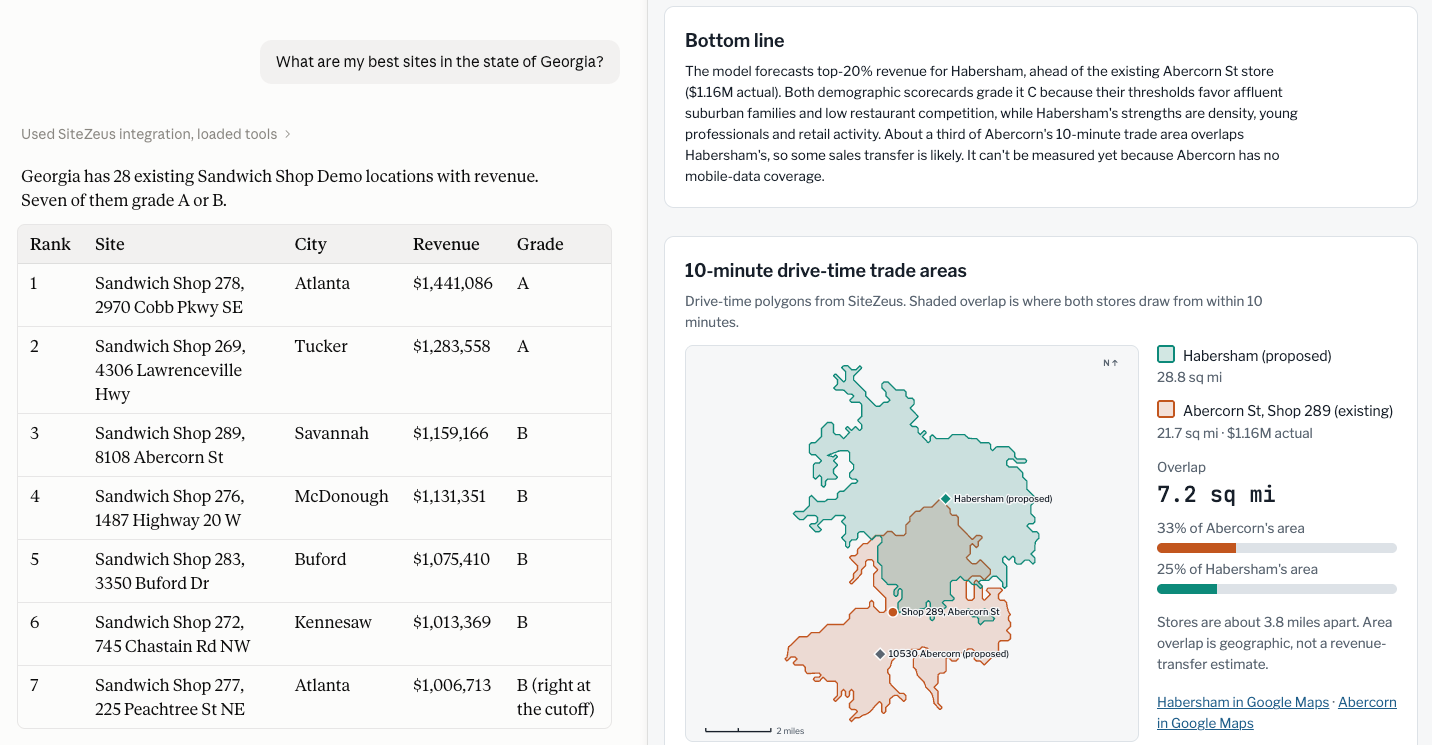
That’s the gap we set out to close: the ease of an AI conversation, backed by the platform that does the real analysis. As of today, SiteZeus Locate connects to the AI of your choice, so the full power of the platform is available wherever your team already works. Here’s why we built it, why now, and what shaped the way we rolled it out.
Why Did We Build This?
Site selection is complex, high-stakes work. Every decision combines data science, GIS, and multiple first- and third-party data sets into a business-critical call. Get it right and the new location is a home run. Get it wrong and it’s a multi-million-dollar mistake.
That complexity is exactly why the work takes so long. Before a team can debate a site, someone has to choose the variables, build the scorecard, set the trade areas, and pull the right data together. Then they repeat it, market by market.
We built this for the work teams do every week: scoring a site a broker just sent over, finding white space in a new market, or estimating how much a new location would take from existing stores. Those questions can start in the AI tool you already have open, with SiteZeus Locate doing the analysis behind the answer.
It scales, too. When our CEO, Sean Ryan, needed custom scorecards for eight brands at once, he built them from a single AI conversation connected to SiteZeus Locate, then reviewed every one.
Two things changed at the same time.
First, AI assistants became part of the normal workday for the teams we serve, and our most AI-savvy customers changed what they expect from them. They have a name for it: GSD, as in “get sh*t done.” They aren’t impressed by an AI that can chat about their data. They want one that helps them get the work finished. When people already ask an assistant to summarize a lease or draft a market memo, asking it to build a scorecard is a short step.
Second, an open standard made the connection practical. The Model Context Protocol, or MCP, lets a platform like ours connect once through an MCP server and work across AI tools, instead of building a separate integration for each one.
I’ll be candid about one more thing. Connecting software to AI tools is getting easier for every company in our space, and we won’t be the only ones to do it. What matters is what the AI can actually do once it’s connected. That question drove every decision below.
What Shaped the Way We Rolled It Out?
Four decisions came directly out of conversations with customers and from testing it on our own work.
It Works With the AI Your Team Already Uses
Teams don’t all use the same assistant, and many companies choose theirs for reasons that have nothing to do with site selection. Tying SiteZeus to one AI tool would have meant asking customers to change how they work to use ours. So it works with Claude, ChatGPT, or whichever AI your team prefers.
Your AI Does the Work, Not Just Reads the Data
An AI that can only look things up gives you faster answers, but it doesn’t give you back the hours. We built SiteZeus Locate so your AI can build scorecards, adjust models, and update projects, not just report on them. That’s the difference between a tool that talks about the work and one that does it. Your AI brings the conversation; SiteZeus brings the data, the models, and the forecasts. Together, they GSD.
It’s Included for Every SiteZeus Locate Customer
Site decisions involve more people than the analyst who runs the model: development leaders, franchise teams, finance, executives. We want all of them able to ask questions and understand the answers without becoming platform experts. Charging extra for AI access would have limited it to a few power users, so it’s included.
Your AI Is Agreeable. SiteZeus Locate Is Honest.
General-purpose AI tools are built to be helpful, and that often means agreeable. Ask one whether a site looks good and it will usually find a way to say yes. That’s fine for drafting an email. It’s the wrong instinct for a decision with millions of dollars behind it.
Connected to SiteZeus Locate, your AI’s answers come from the platform’s models, data, and forecasts, not from the AI’s sense of what you’d like to hear. You get the user experience of AI with the rigor, and the brutal honesty, of SiteZeus Locate.
Your team stays in control. The AI proposes changes and your team approves them, so your scorecards, your weighting, and your criteria stay yours. And because every forecast in SiteZeus Locate is explainable, you can ask why a site scored the way it did and get the answer in plain language, including the demographics, competitive density, traffic patterns, customer movement patterns, consumer behavior signals, and consumer interests behind it.
What Doesn’t Change?
The SiteZeus Locate web and mobile apps stay exactly where they are. Map review, side-by-side comparison, and shared reports still work best on a screen built for them. The data, the models, and the forecasts are the same ones your team relies on today.
In software terms, this is headless site selection: the platform no longer depends on a single interface. For your team, it means something simpler. The full power of SiteZeus, in the AI of your choice.
See It Live
Sean and I will walk through it live at Putting SiteZeus to Work in Your Own AI on November 17 at 2 PM ET. In 45 minutes, you’ll see a brand brief become a finished scorecard, a market’s listings become a shortlist, and one request update every project at once. Bring your questions. We want to hear how your team would use it.
If you’d rather see it with your own markets, schedule a demo.
Recommended Posts